1.3 New Functions from Old
Once we have a basic vocabulary of functions, we can combine them to build increasingly complex structures.
1.3.1 Arithmetic of Functions
Given two functions and with ranges in , we define new algebraic combinations:
One must be remarkably mindful about domains when performing algebra. Consider:
The domains are and . If we define , we compute:
For any , this fraction simplifies to . However, at , the original function is undefined. We cannot simply brush this under the algebraic rug! We conclude that with restricted domain .
1.3.2 Composition of Functions
Instead of adding outputs, what if we feed the output of directly into the input of ? This mathematical assembly line is known as composition, see Figure 1.3.
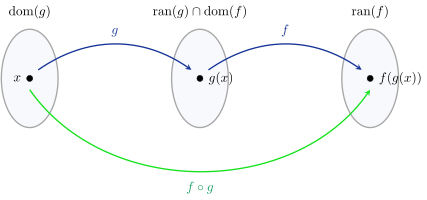
The composition of and , denoted , is defined as:
The domain of is the set of all such that .
Let and . Then:
In general, . Reversing the assembly line fundamentally changes the product. Using the previous example: