3.6 Derivatives of Trigonometric Functions
We will now take a brief hiatus from our steady march through general theorems to discuss the differentiation of concrete functions. Our machinery thus far smoothly handles the differentiation of polynomials and rational functions. However, if we survey our grand taxonomy of functions in Section 1.6, we find several wild species remaining:
-
•
Radicals (e.g., roots like )
-
•
Trigonometric functions (, etc.)
-
•
Exponentials and Logarithms ()
-
•
Non-elementary functions
In this section, we will hunt down the derivatives of the fundamental trigonometric functions. We will lay down the foundation for sine and cosine, and leave the more exotic members of the taxonomy until we have derived another sophisticated tool (the Chain Rule).
3.6.1 The Algebraic Path: Hadamard’s Advice
We start with the most fundamental wave of all: . Let us boldly apply our first-principles definition of the derivative and observe where the machinery gets stuck:
Substituting inevitably brings us to the classic indeterminate form . We desperately need to eliminate the in the denominator. Remembering our fundamental limit , a strategy crystallizes: we must factor the numerator into the form .
This requires hunting for a trigonometric identity to expand . Which identity? Here is a powerful rule of thumb: every trigonometric identity can be derived from Euler’s identity.
As the great French mathematician Jacques Hadamard once famously remarked:
The shortest path between two truths in the real domain passes through the complex domain.
We can find our real-valued addition formulas by taking a quick, elegant detour through the complex plane using Euler’s formula: .
For any , we have:
Consider the complex exponential . By Euler’s formula, the left-hand side is simply:
On the right-hand side, we utilize the standard algebraic laws of exponents to factor the expression, applying Euler’s formula to each piece:
Equating the real parts and the imaginary parts of (3.14) and (3.15) yields the desired identities. ∎
Armed with Lemma 3.6.1, we can conquer the derivative of sine.
The functions and are differentiable for all , and their derivatives are given by:
Applying our addition formula to the limit definition of the derivative, we obtain:
Notice that the variable governing the limit is . Thus, we may treat and as constants and pull them out:
Here we use the fundamental limit . But what of the second term?
The presence of and the constant is screaming for the Pythagorean identity, . By multiplying the numerator and denominator by the conjugate , we can force a difference of squares.
Let us evaluate the second limit utilizing this Pythagorean trick:
Taking the limit as , the expression splits:
Substituting these evaluated limits back into (3.16), we conclude:
An analogous calculation confirms that . ∎
The derivatives of the remaining trigonometric functions fall out instantly from the Quotient Rule. For instance, to find the derivative of :
Prove the remaining differentiation rules:
Since there are myriad trigonometric identities linking these functions, any derivative computation might yield multiple correct, albeit different-looking, answers. As a general rule, you should simplify as much as possible. However, do not panic if the expression you write down looks algebraically distinct from your friend’s answer; both might be entirely correct! For example, in the previous computation, we could just as easily have written the final answer as without moving to .
3.6.2 The Geometric Path: Newton’s Vision
The proof of Theorem 3.6.2 gets the job done and carries a pleasant algebraic flavor—we massaged the limit via trigonometric identities into something recognizable. But it can feel a bit like symbol pushing.
Is there a geometric proof of the differentiation rules from first principles? Indeed there is. It uses nothing more than the geometric definitions of sine and cosine, and a bit of high school geometry. 2 bonus points: it explains why we must use radians instead of degrees, and is more faithful to the geometric vision of Isaac Newton.
Why do calculus textbooks furiously insist on measuring angles in radians? Because on a unit circle, an angle of radians subtends an arc of exactly length . This direct equivalence between angle and geometric length is what allows us to relate trigonometric limits directly to the physical geometry of the circle. Degrees are an arbitrary human construct; Nature uses radians for her geometry.
Let us visualize the unit circle in Figure 3.6. Let . An angle of radians means the arc length from along the circle is exactly units. Let ; thus, . Similarly, let , meaning the total arc length to is . The length of the arc between and is therefore exactly .
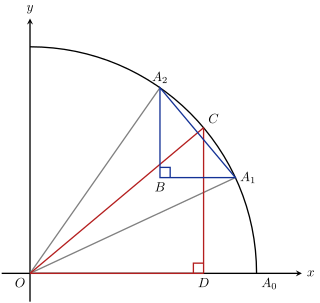
Let be the midpoint of the arc . Because is an isosceles triangle (bounded by radii of length 1), the ray acts as the perpendicular bisector of the chord . The coordinates of are naturally .
Let be the geometric projection of onto the -axis, so . Finally, let be the intersection of the horizontal line passing through and the vertical line passing through . Then .
We now have two right-angled triangles of interest: and . Let us trace the angles to see that they are, in fact, similar! In , the leg is horizontal and is vertical. The angle is exactly . In , the leg is horizontal and is vertical. A quick chase of complementary angles—noting that the chord is perpendicular to —reveals that the entire triangle is simply rotated by 90 degrees and scaled. Consequently, the angle precisely matches .
Using the similarity , we may equate the ratios of their corresponding sides. Specifically, the ratio of the horizontal leg to the hypotenuse in both triangles must be identical:
Let us carefully express these lengths in terms of our spatial coordinates:
-
•
is the horizontal distance between and , which is .
-
•
is the vertical height of , which is .
-
•
is the radius of the unit circle, strictly .
Substituting these values into (3.17) gives:
Here comes the coup de grâce. We take the limit as . For infinitesimally small angles, the length of the straight chord is asymptotically equivalent to the length of the arc . Because we are working in radians, that arc length is identically ! Thus, as , we have .
Taking the limit yields:
This is a brilliantly geometric proof, relying on nothing more than the similarity of triangles and the true definition of radian angle measure.
Find a different pair of corresponding sides in the similar triangles and to geometrically prove that .
Find the derivative of the following functions: