5.2 Signed Quantities and Net Change
In our initial exploration of integration, we treated speed as an inherently non-negative scalar quantity. In classical mechanics, however, motion is directed: we must distinguish between advancing forward and retreating backward. This gives rise to velocity, which represents signed speed.
Let us modify the story at the beginning of the previous section to illustrate signed speed. Picture a straight road as a number line, with the positive direction pointing to the right. You leave Home, at position at time , and drive in the positive direction past Campus, at position , until you reach a Friend’s place further along at time . Then you remember you have a lecture, so you turn around and drive back in the negative direction to Campus and arrive at time . The questions are simple: how many miles from home, and how many miles traversed?
The velocity of an object moving along a line is its signed speed, which we denote by . The sign records the direction of motion:
-
•
if the object moves in the positive direction at time , then ;
-
•
if the object moves in the negative direction at time , then .
So speed tells you how fast you are going, and velocity also tells you which way. Let denote the position of the object at time .
The net displacement (also called the signed distance) travelled between times and is
Inside the integral we have renamed the integration variable to . This is because the letter is already being used for the upper limit. Writing is a very common mistake by inexperienced freshman: using one symbol for two different jobs. The integration variable is a dummy variable: it can be given any name we like. We will come back to this idea when we meet sigma notation in Section 5.3.
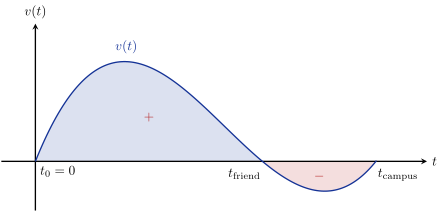
Now go back to our trip. Start the clock when you leave home, so and . From until you drive forward, so . From until you drive backward, so (see Figure 5.3). This gives the two answers to our question.
-
•
The net displacement counts motion in the negative direction against motion in the positive direction:
-
•
The total distance travelled counts every bit of motion as positive, whichever way you were going:
Your car’s odometer measures total distance travelled. It keeps going up no matter which way you drive, because it only sees the speed . A GPS showing how far you are from home measures net displacement. When you turn around, that number starts going down again, because driving backward undoes driving forward. At the end of the trip above, the odometer shows the full Home–Friend–Campus distance. The GPS shows only . In summary:
-
(1)
Net Displacement (): The algebraic sum of forward and backward motions. Periods of negative velocity cancel out portions of forward progress.
-
(2)
Total Distance Traveled (): The absolute geometric mileage recorded by a working odometer, where every direction is reckoned positively.
An integral of a signed quantity measures net change: area above the axis counts as positive and area below the axis counts as negative. To measure the total amount, with no cancellation, integrate the absolute value.
Both quantities above come down to the same geometric problem. We need to compute the area of the region bounded by
For most functions we cannot find this area exactly with elementary geometry. Instead, we will approximate the region by many thin rectangles and add up their areas. To do that efficiently we need a compact way to write long sums.