2.3 Finding Limits Intuitively: Graphs and Numerics
To properly evaluate limits, we must be careful with domains. Before we take , we must ensure the function actually makes sense near .
Consider the function
Let us determine its domain, .
For to be a real number, two conditions must be met:
-
(i)
The denominator cannot be zero: .
-
(ii)
The expression inside the square root must be non-negative (to remain in ): .
Let us analyze the first condition:
Thus, we require . Combining this with , we deduce the domain is:
Now, let us find the limit as :
There are two immediate, intuitive heuristics to approximate : graphically and numerically.
Method 1 — The Graph.
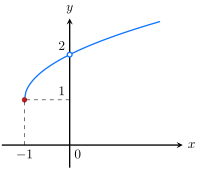
If we were to plot , we would trace out a gentle curve starting from that passes smoothly toward the coordinate , albeit with a microscopic “hole” punctured exactly at , see Figure 2.4. We conclude .
Method 2 — Numerics.
Alternatively, we can use a calculator to systematically probe the values of as approaches from both the left (negative values) and the right (positive values), see Table 2.1.
| undefined |
The table tells a compelling story. As the -values tighten their grip around , the outputs march toward the value . We formalize this observation by writing:
The limit is oblivious to the destination itself; it only cares about the journey. The literal value of has absolutely no bearing on .