2.6 The Zoo of Limit Behaviors: What Could Go Wrong?
Before we formalize the concept of continuity, it is highly instructive to step back and look at the big picture. Given a function and a point , we want to understand the local behavior of near .
The behavior of limits at a point can be broadly categorized into a hierarchy, ranging from bad to good behaviors.
-
1.
At least one one-sided limit does not exist.
Consider the wildly misbehaved function given by:As , the argument rockets to infinity. This causes the sine function to oscillate furiously between and , never settling on a single value. Consequently, simply does not exist. The function suffers a catastrophic breakdown at the origin.
-
2.
Both one-sided limits exist, but they are unmatched.
Now consider a simple step function:Here, the limits from both sides exist perfectly well: and . However, they fail to agree. The graph exhibits a sudden jump, tearing the curve apart.
-
3.
Both one-sided limits exist and are equal.
Moving up the hierarchy, we find situations where the one-sided neighbors at least agree on a destination:The limit exists, but it might not match the actual function value , or might even be undefined.
Invent 3 functions corresponding to 3 scenarios above, then draw their graphs.
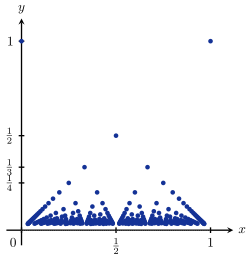
You might assume that the “bad” example in the first category represent the worst possible behavior of a function. However, there is something even worse: the Thomae’s function, also known as the popcorn function
see Figure 2.11. This pathological beast is continuous at every irrational number, yet discontinuous at every rational number.
The realization that such objects could exist forced mathematicians to abandon pure geometric intuition in favor of rigorous, algebraic definitions. We need a concept stricter than our “good” limit behavior to build a robust foundation for calculus. We need continuity.